Connect WhatsApp Live Agent
Enter your WhatsApp number (or simulated phone number) to open a direct real-time webhook bridge. Your English practice messages will route instantly to your WhatsApp, and incoming replies will sync straight back to this frontend screen!
Writing Performance Blueprint
Diagnostic Evaluation & IELTS Band Score Analysis
Performance Breakdown Matrix
| Assessment Domain | Vibe Metric | Strategic Diagnostic Observations |
|---|---|---|
| Task Achievement | Band 4.5 | The response is significantly short (96 words vs. the 150-word minimum threshold). Crucial map transitions visible in the prompt artwork were completely omitted—most notably, the absolute removal/destruction of the fishing port and the expansion of the sea area. The final sentence inaccurately mentions the “construction of fishing” which contradicts the visual data. |
| Coherence & Cohesion | Band 5.5 | An overview statement is present, and basic cohesive linkers are utilized (“Moreover”, “Furthermore”) to sequence points. However, logical progression is disrupted by broken structures, and paragraph division feels abrupt due to the limited volume of information. |
| Lexical Resource | Band 5.5 | Functional vocabulary for reporting structural changes is present (“converted to”, “transform into”, “constructed”). The word choice is highly repetitive, and errors like “construction of lands” or “golf play area” show a slight lack of precision in word combinations. |
| Grammatical Range | Band 5.0 | Frequent grammatical breakdowns distort meaning. There is a systemic omission of necessary passive forms and verbs (e.g., “farmland and forest park situated which transform”). Inconsistent tense switches occur between past reporting and present observations within single clauses. |
Task 1: Academic Report Diagnostic & Response
Word Count Split: 96 WordsInstructional Strengths
Appropriately selected key visual features such as the transformation of farmland/forest into a golf course and tennis courts. Clear division into basic functional sections (Introduction, Overview, and Body paragraphs) provides an appropriate structural baseline.
Structural Weaknesses
- Severe word count deficit (96/150 words), missing reporting depth required for higher score tiers.
- Incomplete relative clause fragment: “…park situated which transform into…” (lacks helping verbs and past participle alignment).
- Factual misinterpretation of data: “…with the construction of fishing.” The fishing port was completely removed, not constructed.
- Awkward collations and missing prepositions/articles: “modifications occurred” (should be that occurred), “in hotel” (should be at the hotel).
Englivio Recommended Sample (Band 8.0+ Model)
180 Words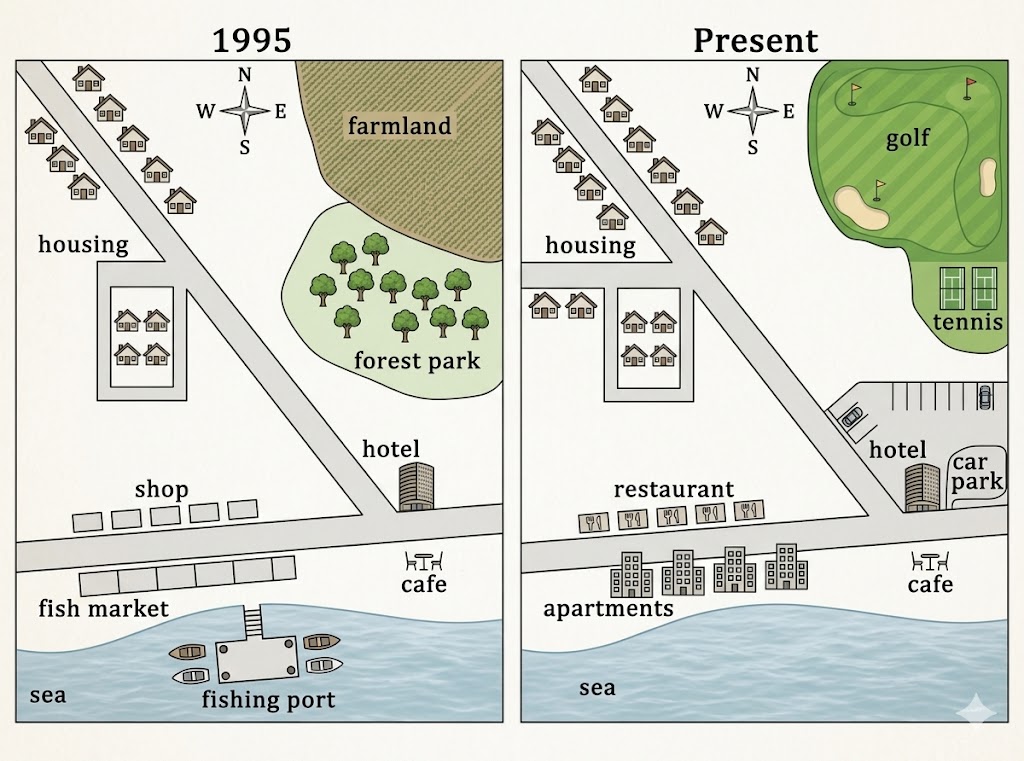
The given maps clarify the infrastructural modifications that occurred in a specific coastal town from 1995 to the present day.
Overall, the town experienced significant modernization, transforming from a semi-rural port layout into a more commercialized, leisure-oriented coastal destination. The most prominent changes include the commercial expansion of the southern strip and the total repurposing of agricultural and green lands into sports infrastructure.
In the northeast sector, the farmland and forest park present in 1995 were entirely cleared to make way for a large golf course, complemented by a pair of tennis courts built just south of it. Concurrently, the residential sector on the western side expanded with the addition of multiple housing units. While the hotel building remained intact, its amenities were upgraded to include an adjacent car park on its eastern side.
Further south along the coast, the commercial zone underwent major re-development. The row of independent shops was converted into a series of restaurants, and the fish market was completely replaced by modern apartment blocks. Notably, the maritime infrastructure was completely altered; the original fishing port was decommissioned and dismantled, which effectively expanded the open sea area.
Englivio Strategic Action Roadmap
- Comprehensive Map Analysis: Ensure all map details are fully scrutinized. Changes must account for elements added, replaced, or completely destroyed (such as the fishing port).
- Mastering Passive Tone Grammar: Practice descriptions of historical layout shifts using appropriate passive structures (e.g., “was converted into”, “was replaced by”, or “has been transformed into”) rather than active simple present forms.
- Expanding Data Coverage: Teach the student to detail both directions, layout structures, and specific expansions (such as the addition of a car park right next to the hotel) to comfortably cross the mandatory 150-word volume threshold.
Confirm Your Details
Please verify your full name before commencing the test. An invigilator will provide your identity registry details if required.
Time Expired
The test session duration has run to completion. Your text workspace is now locked.
Question Tags
1) What is a Question Tag?
Definition and the basic rule.
A question tag is a short phrase added to the end of a statement to turn it into a question. We use them to check if information is true, or to ask for agreement.
Negative Statement ➔ Positive Tag
- It is raining, isn’t it?
- You have finished, haven’t you?
- It isn’t raining, is it?
- You haven’t finished, have you?
2) Forming the Tag
Matching the verb and pronoun.
To form a question tag, look at the verb and the subject in the main sentence.
| Sentence Pattern | Rule | Example |
|---|---|---|
| Has an Auxiliary Verb (is, are, was, have, will, etc.) | Repeat the same auxiliary verb in the tag. | She is coming, isn’t she? They will help, won’t they? |
| No Auxiliary Verb (Simple Present / Past) | Use do, does, or did. | You play tennis, don’t you? He went home, didn’t he? |
| The Subject | Always use a pronoun in the tag, never a noun. | John is tall, isn’t he? The car is fast, isn’t it? |
3) Special Cases & Exceptions
Irregular tags you need to memorize.
There are a few situations in English where the question tag does not follow the standard rules.
| Statement | Tag | Example |
|---|---|---|
| I am | aren’t I? | I am late, aren’t I? (NOT “am not I?”) |
| Let’s (Let us) | shall we? | Let’s go for a walk, shall we? |
| Imperatives (Commands) | will you? | Close the door, will you? Don’t drop that, will you? |
| This / That | it | This is your book, isn’t it? |
| These / Those | they | Those are nice shoes, aren’t they? |
| There is / are | there | There is a problem, isn’t there? |
4) Sentences with Hidden Negatives
Never, rarely, nobody, nothing.
If the main statement contains a word with a negative meaning (like never, rarely, seldom, hardly, nobody, or nothing), the statement is considered negative. Therefore, the tag must be positive.
- She never smiles, does she?
- We rarely see them, do we?
- Nothing happened, did it?
- She never smiles, doesn’t she?
- We rarely see them, don’t we?
Use it for things (nothing, something, everything): Everything is fine, isn’t it?
5) Pronunciation & Intonation
How you say it changes the meaning.
The meaning of a question tag changes depending on how your voice moves at the end of the sentence.
| Intonation | What it means | Example context |
|---|---|---|
| Voice goes UP ↗ | You are asking a real question. You don’t know the answer and want information. | You haven’t seen my keys, have you? ↗ (I really don’t know where my keys are) |
| Voice goes DOWN ↘ | You are not asking a real question. You are just asking the other person to agree with you. | It’s a beautiful day, isn’t it? ↘ (I know it’s beautiful, I just want you to agree) |
Parallel Structure
1) What is Parallel Structure?
Definition, the golden rule, and basic examples.
Parallel structure (also known as parallelism) is the repetition of a chosen grammatical form within a sentence. By making each compared item or idea follow the same grammatical pattern, you create a parallel construction that is easy to read and understand.
- She likes baking, running, and reading.
- The teacher is smart, patient, and kind.
- She likes baking, to run, and reading. (mixed verb forms)
- The teacher is smart, patient, and a kind person. (mixed adjective and noun phrase)
2) Coordinating Conjunctions
Using FANBOYS (for, and, nor, but, or, yet, so).
When you connect two or more items using a coordinating conjunction (most commonly and or or), the items must be grammatically parallel.
| Level | Correct (Parallel) | Incorrect (Faulty) |
|---|---|---|
| Words | Please bring a pen, pencil, and notebook. | Please bring a pen, pencil, and something to write on. |
| Phrases | We searched in the car, under the bed, and behind the sofa. | We searched in the car, under the bed, and checked the sofa. |
| Clauses | He said that he was sorry and that he would fix it. | He said that he was sorry and he promises to fix it. |
3) Correlative Conjunctions
Pairs like: Either/or, neither/nor, not only/but also.
Correlative conjunctions come in pairs. The grammatical structure that follows the first half of the pair must be identical to the structure that follows the second half.
| Conjunction Pair | Example of Parallel Structure |
|---|---|
| Either / Or | You can either stay here or come with us. (Verb phrase balances verb phrase) |
| Neither / Nor | The movie was neither accurate nor entertaining. (Adjective balances adjective) |
| Not only / But also | She is not only a brilliant scientist but also an excellent writer. (Noun phrase balances noun phrase) |
| Both / And | We need both more time and better equipment. (Noun phrase balances noun phrase) |
4) Parallelism in Comparisons
Balancing items joined by “than” or “as”.
When you are comparing two things, the two things being compared must be built using the same grammatical structure.
- Riding a bike is faster than walking.
- To learn is to grow.
- I would rather pay for my ticket than wait in line.
- Riding a bike is faster than to walk.
- To learn is growing.
- I would rather pay for my ticket than waiting in line.
5) Bulleted Lists (Resumes & Documents)
Keeping list items consistent.
When creating a list, especially on a resume or in a professional document, start every bullet point with the same part of speech (usually an active verb).
Duties included:
- Managed a team of five employees.
- Designed the new company logo.
- Organized weekly scheduling.
Duties included:
- Managed a team of five employees.
- Designing the new company logo.
- I was responsible for weekly scheduling.
6) Mixing Voice (Active vs. Passive)
Keeping verbs in the same voice.
Another common way parallelism is broken is by mixing active voice and passive voice in the same sentence or clause sequence.
| Type | Example | Problem/Fix |
|---|---|---|
| Mixed Voice (Incorrect) | The committee approved the budget, and the schedule was finalized by them. | Shifts from active (“approved”) to passive (“was finalized”). |
| Parallel Voice (Correct) | The committee approved the budget and finalized the schedule. | Both verbs are now active, sharing the same subject. |
Inversion
1) What is Grammatical Inversion?
Definition, standard order, and emphasis.
Grammatical inversion happens when we reverse the normal word order of a sentence. Instead of the standard Subject + Verb, we use Verb/Auxiliary + Subject.
- I had never seen such a beautiful sunset.
- The rain came down.
- She is so intelligent that she passed easily.
- Never had I seen such a beautiful sunset.
- Down came the rain.
- So intelligent is she that she passed easily.
2) Inversion with Negative Adverbs
Never, Rarely, Seldom, Hardly, Scarcely, No sooner.
When a sentence begins with a negative or restrictive adverb (to make it sound more striking), we invert the subject and the auxiliary verb.
| Adverb | Standard Sentence | Inverted Sentence |
|---|---|---|
| Never | I have never felt so alone. | Never have I felt so alone. |
| Rarely / Seldom | He rarely leaves his house. | Rarely does he leave his house. |
| Hardly / Scarcely | I had hardly arrived when it rained. | Hardly had I arrived when it rained. |
| No sooner | They had no sooner left than it broke. | No sooner had they left than it broke. |
| Not only | She is not only smart, but also kind. | Not only is she smart, but also kind. |
do, does, or did in the inverted form (e.g., “does he leave”).3) Conditional Inversions
Dropping “If” in formal English.
In highly formal writing, you can omit the word if in conditional sentences by moving the auxiliary verb (should, were, or had) before the subject.
- Normal: If you need help, call me.
- Inverted: Should you need help, call me.
- Normal: If I were rich, I would travel.
- Inverted: Were I rich, I would travel.
- Normal: If they had known the truth, they would not have come.
- Inverted: Had they known the truth, they would not have come.
4) Adverbs of Place & Direction
Here, There, Up, Down, and Prepositional Phrases.
When sentences start with expressions of place or direction, the main verb moves before the subject. This is common in literature and storytelling.
| Type | Normal Order | Inverted Order |
|---|---|---|
| Here / There | The bus comes here. | Here comes the bus. |
| Direction Adverbs | The spider went up. | Up went the spider. |
| Prepositional Phrases | A beautiful castle sat on the hill. | On the hill sat a beautiful castle. |
- Here comes the train.
- Away flew the bird.
- Here it comes. (Not “Here comes it”)
- Away it flew. (Not “Away flew it”)
5) Emphasizing with “So” and “Such”
Using adjectives and nouns at the start of a sentence.
To heavily emphasize an adjective or noun, we can place So + Adjective or Such + Noun at the beginning of the sentence, followed by inverted word order.
| Structure | Example | Meaning |
|---|---|---|
| So + Adjective | So cold was the wind that we stayed inside all day. | The wind was incredibly cold. |
| So + Adverb | So quickly did he run that nobody could catch him. | He ran incredibly fast. |
| Such + Noun | Such is the power of love that it can heal any wound. | The power of love is immense. |
6) Restrictive “Only” and Prepositional “No”
Only after, Only then, Under no circumstances.
Phrases beginning with Only or containing the word no often trigger inversion when placed at the front of a sentence.
| Phrase | Rule | Examples |
|---|---|---|
| Only + Time Expression | Invert the main clause (not the time clause). |
|
| Preposition + No | Invert the auxiliary and subject immediately. |
|
Paragraph Writing
1) What is a Paragraph?
The building blocks of writing.
A paragraph is a group of sentences that share one main idea. Instead of writing one massive wall of text, we break our writing into paragraphs to make it easy to read and understand.
- Indentation: The first line is usually pushed in (indented) by about 5 spaces.
- Block style: Alternatively, skip a full blank line between paragraphs.
- The Wall: A whole page of text without any paragraph breaks.
- The Orphan: A paragraph that is only one sentence long (usually, paragraphs need 3-5 sentences).
2) The “Hamburger” Structure
A deliciously simple way to organize your thoughts.
A great paragraph is built just like a hamburger. It needs a top bun to hold it together, the meat in the middle to give it flavor, and a bottom bun to finish it off.
Introduces the main idea. Holds everything together.
3 to 4 sentences giving facts, examples, and explanations.
Wraps up the paragraph and summarizes the main point.
3) The Topic Sentence
The boss of the paragraph.
The topic sentence is usually the first sentence of the paragraph. It tells the reader exactly what the paragraph is going to be about. It should be clear and interesting.
Too broad, too narrow, or boring.
- I am going to tell you about dogs. (Boring)
- My dog has four legs. (Too narrow, nowhere to go)
- Animals are in the world. (Too broad)
Clear, specific, and sets a direction.
- Dogs make the perfect family pets for several reasons.
- Training a new puppy requires patience and consistency.
- There are three distinct differences between wolves and domestic dogs.
4) Supporting Details
Proving your point.
Once you have your topic sentence, you must prove it or explain it. You do this using supporting sentences. A good paragraph usually has 3 to 5 supporting sentences.
- Facts: “A dog’s sense of smell is 10,000 to 100,000 times more sensitive than ours.”
- Examples: “For instance, golden retrievers are known for being gentle with toddlers.”
- Explanations: “Because they are pack animals, they naturally want to protect their human families.”
5) Transition Words
The glue that connects your sentences.
Transition words act like bridges. They help the reader move smoothly from one sentence to the next so the paragraph doesn’t sound robotic or choppy.
| Purpose | Transition Words & Phrases |
|---|---|
| Adding Information | First, Second, Also, Furthermore, In addition, Moreover |
| Giving Examples | For example, For instance, Specifically, Such as |
| Showing Contrast | However, On the other hand, But, Although, Unlike |
| Concluding / Wrapping Up | Finally, In conclusion, As a result, To sum up, Therefore |
6) The Perfect Paragraph Example
Putting it all together.
Let’s look at a complete paragraph. Notice how it starts with a clear idea, uses transition words to give examples, and wraps up neatly at the end.
Reading Time In English
1) The “O’clock” and “Half Past”
The top and bottom of the hour.
In English, we have specific ways to talk about time when the minute hand is perfectly at the top (12) or perfectly at the bottom (6) of the clock.
2) The “Quarters”
Dividing the clock into 15-minute slices.
Instead of saying “fifteen” or “forty-five,” native speakers very often use the word quarter (which means 1/4 of an hour, or 15 minutes).
Used when the time is exactly 15 minutes after the hour. The minute hand is on the 3.
Example: 10:15 = Quarter past ten
Used when there are exactly 15 minutes left until the next hour. The minute hand is on the 9.
Example: 1:45 = Quarter to two
3) Minutes “Past” vs. Minutes “To”
Which side of the clock is the minute hand on?
When reading time the traditional British way, you must look at which half of the clock the minute hand is resting on.
| Rule | Minutes | Formula | Examples |
|---|---|---|---|
| Right Side (Past) | Minutes 1 to 29 | [Minutes] past [Current Hour] |
|
| Left Side (To) | Minutes 31 to 59 | [Minutes left] to [Next Hour] |
|
Example: 6:04 = Four minutes past six.
4) The Digital Way (The Easy Way)
How Americans (and most of the world) often speak today.
While learning “past” and “to” is important for understanding native speakers, it is completely acceptable and very common to just read the numbers exactly as they appear on a digital clock.
- 6:10 = Six ten
- 9:45 = Nine forty-five
- 2:30 = Two thirty
If the minute is less than 10, pronounce the zero as the letter “O”.
- 4:05 = Four oh five
- 8:09 = Eight oh nine
5) Common Time Mistakes
Watch out for these tricky situations.
Mistake 1: AM / PM vs. O’clock
You cannot use “o’clock” and “AM/PM” in the same sentence. Choose one.
I will meet you at 5 o’clock PM.
I will meet you at 5 o’clock.
OR
I will meet you at 5 PM.
Mistake 2: 12:00 Confusion
12:00 can be confusing because it changes from AM to PM. Use words to make it perfectly clear.
- It is Noon.
- It is Midday.
- It is Midnight.
Mistake 3: Prepositions of Time
Make sure you use the correct preposition when talking about when something happens.
| Preposition | When to use it | Examples |
|---|---|---|
| AT | Specific clock times, night, and holidays. | At 5:30. At midnight. At breakfast. |
| IN | Months, years, seasons, and parts of the day. | In the morning. In 2024. In summer. |
| ON | Days of the week and specific dates. | On Monday. On July 4th. On my birthday. |
Order Of Adjectives
1) The “Royal Order” of Adjectives
Why “big red balloon” sounds right, but “red big balloon” sounds wrong.
Native English speakers naturally use a specific order when placing multiple adjectives before a noun. If you mix up the order, the sentence will sound very strange, even if it is technically understandable.
2) The Master Cheat Sheet
The standard order from first to last.
You can remember this order using the acronym OSASCOMP (Opinion, Size, Age, Shape, Color, Origin, Material, Purpose), preceded by the Quantity.
| # | Category | What it answers | Examples |
|---|---|---|---|
| 1 | Quantity | How many? | A, an, the, some, five, many |
| 2 | Opinion | What do you think of it? | Beautiful, ugly, delicious, weird, lovely |
| 3 | Size | How big is it? | Huge, tiny, tall, short, massive |
| 4 | Age | How old is it? | Old, new, young, ancient, antique |
| 5 | Shape | What shape is it? | Round, square, flat, oval |
| 6 | Color | What color is it? | Red, blue, dark, pale, blonde |
| 7 | Origin | Where is it from? | Italian, French, lunar, Victorian |
| 8 | Material | What is it made of? | Wooden, metal, silk, plastic |
| 9 | Purpose | What does it do? | Sleeping (bag), mixing (bowl), running (shoes) |
“I bought two (1) beautiful (2) tiny (3) antique (4) round (5) silver (6) French (7) metal (8) pocket (9) watches.”
Note: You should almost never use this many adjectives in real life! Usually, we max out at 2 or 3.
3) Real-World Examples
Breaking down combinations of 2 or 3 adjectives.
“She drives a wonderful old Italian sports car.”
- Wonderful = Opinion
- Old = Age
- Italian = Origin
“He is wearing an ugly big orange tie.”
- Ugly = Opinion
- Big = Size
- Orange = Color
“We sat around a new square wooden table.”
- New = Age
- Square = Shape
- Wooden = Material
“I need to buy small black running shoes.”
- Small = Size
- Black = Color
- Running = Purpose
4) Common Mistakes to Avoid
Where English learners (and sometimes natives!) get tripped up.
Mistake 1: Putting Fact before Opinion
Always tell us how you feel about the object before you tell us the cold, hard facts about it.
A wooden beautiful chair.
A beautiful wooden chair.
Mistake 2: Mixing up Size and Color
Size comes very early in the sequence, while color comes right before the noun’s origin or material.
Look at that red big balloon!
Look at that big red balloon!
Mistake 3: Putting Age before Size
Physical size generally takes precedence over how old something is.
An old massive castle.
A massive old castle.
If adjectives come from different categories (e.g., Size and Color), you do not need a comma between them (a big red car).
If they come from the same category (e.g., two opinions), you do need a comma or the word “and” (a beautiful, elegant dress / a red and white flag).